Looking for an AI automation agency in Singapore that talks in outcomes, not buzzwords? I'm Joshua. My small, vetted team builds practical AI automation for SMEs — the quiet systems that do the boring work you waste hours on every week: replying to WhatsApp enquiries, chasing leads, raising invoices, copying data between apps and pulling the reports you dread building by hand. We wire these into the tools you already use, test them on your real data, and hand them over working. From S$400/month, no lock-in, and you own everything we build.
This is deliberately down-to-earth automation for owners who just want fewer manual tasks and faster replies to customers. If you need fully autonomous decision-making systems, that's a different service — see agentic AI development for autonomous agents — but most Singapore SMEs get their biggest wins from the practical workflow automation on this page first.
What an AI automation agency in Singapore actually does for SMEs
Automation is not one product. It's a set of small, reliable systems that remove copy-paste, waiting and "I forgot to follow up" from your day. Here's what I'm asked to build most often:
- WhatsApp automation — instant acknowledgements so enquiries never sit unanswered, auto-replies to common questions, order and booking capture, confirmations and reminders, and clean hand-off to a real person when something needs a human. WhatsApp is how Singapore actually buys, so it's usually the highest-impact place to start. Want a smarter conversational layer on top? That overlaps with AI chatbot development.
- Lead follow-up automation — the moment an enquiry lands (web form, WhatsApp, Instagram, a marketplace), the system replies in seconds, asks a few qualifying questions, logs the lead to your CRM or Google Sheet, pings your salesperson, and keeps nudging so hot leads don't go cold over the weekend.
- Back-office automation — generating invoices and quotations, data entry between systems, weekly and monthly report generation, payment and renewal reminders, and reconciling numbers that currently live in three different spreadsheets.
- Integrations and data sync — connecting Google Sheets, CRMs (HubSpot, Pipedrive, Zoho), WhatsApp, Telegram, email, e-commerce platforms and accounting tools so a record entered in one place appears everywhere it should, with no manual re-keying.
The automations that pay back fastest
If you only do one thing, make it lead response. In Singapore's competitive service markets, the business that replies first usually wins the job — and an automation that answers in seconds, day or night, quietly beats a competitor who replies the next morning. The second-fastest payback is usually back-office admin: invoicing, reminders and reports are pure repetitive cost, so every hour you automate is an hour returned to billable or growth work. I'll always tell you honestly which automation will move the needle for your business, and which is a nice-to-have that can wait.
Not sure whether you're ready? These are the tell-tale signs it's time to automate:
- Someone on your team retypes the same information into two or three different systems.
- Enquiries arrive faster than a human can reply, and some slip through the cracks.
- Month-end reporting is a manual spreadsheet ritual that eats a whole afternoon.
- Leads go cold because follow-up depends on someone remembering to do it.
- You're paying for two tools that should talk to each other but don't.
No-code tool vs done-for-you automation
You can absolutely build simple automations yourself in Zapier or Make — and for a two-step "when a form is submitted, add a row to a sheet" job, you probably should. The gap shows up the moment your process has real logic, higher volume, or touches something that must not fail silently. Here's the honest comparison:
| What matters | DIY no-code (you build it) | Done-for-you automation (my team) |
|---|---|---|
| Getting started | You learn the tool, map the logic and debug it yourself | I scope it, build it and hand it over working |
| Edge cases and errors | Silent failures are common — you find out when a customer complains | Error handling, retries and alerts are built in from the start |
| Complex logic and volume | Gets brittle and pricey past a handful of steps | Custom code or self-hosted n8n handles real logic and scale |
| Integrations | Limited to the tool's supported connectors | Any API — WhatsApp, Telegram, CRMs, accounting, your own database |
| Ongoing cost | Per-task pricing that climbs as you grow | Fixed from S$400/mo per developer; self-hosted options cut tool fees |
| When it breaks | Your problem to fix, usually at the worst time | My team fixes it; 30-day replacement guarantee on the developer |
| Ownership | Locked into one vendor's ecosystem | You own the workflows, code and documentation — 100% |
Done-for-you doesn't mean over-engineered. It means someone who does this daily picks the right approach, builds it properly, and is accountable when something changes upstream — like WhatsApp updating its API or a supplier changing their export format.
The tools I build with — n8n, Make, Zapier and custom code
I'm not religious about tools. For simple, standard connections between popular apps, Make or Zapier is often all you need, and I'll set it up so you can maintain it yourself. For anything with real branching logic, higher volume, the WhatsApp Business API, or data you'd rather not push through a third-party cloud, self-hosted n8n automation or custom code is usually cheaper and more reliable over a year. When an off-the-shelf workflow can't do the job, we drop into a proper custom software build. My rule is simple: recommend the lightest, cheapest thing that reliably does the job — even when that means less work billed to me. AI models get added only where they earn their place: reading messy text, drafting replies, classifying enquiries and extracting data — used with guardrails, not as a gimmick.
Industries I build automation for
Automation isn't industry-specific, but the pain points are. These are the Singapore businesses I build for most:
- Retail and e-commerce — order capture, stock and price sync, abandoned-enquiry follow-up and review requests, often alongside an e-commerce store build (I've built WooCommerce stores and auto-purchase bots).
- F&B and services — WhatsApp bookings, reservation confirmations, reminders and feedback collection.
- Agencies and professional services — lead intake, proposal and invoice generation, client onboarding checklists and reporting automation.
- Real estate, rentals and events — enquiry routing, availability tracking and Telegram-based ops workflows.
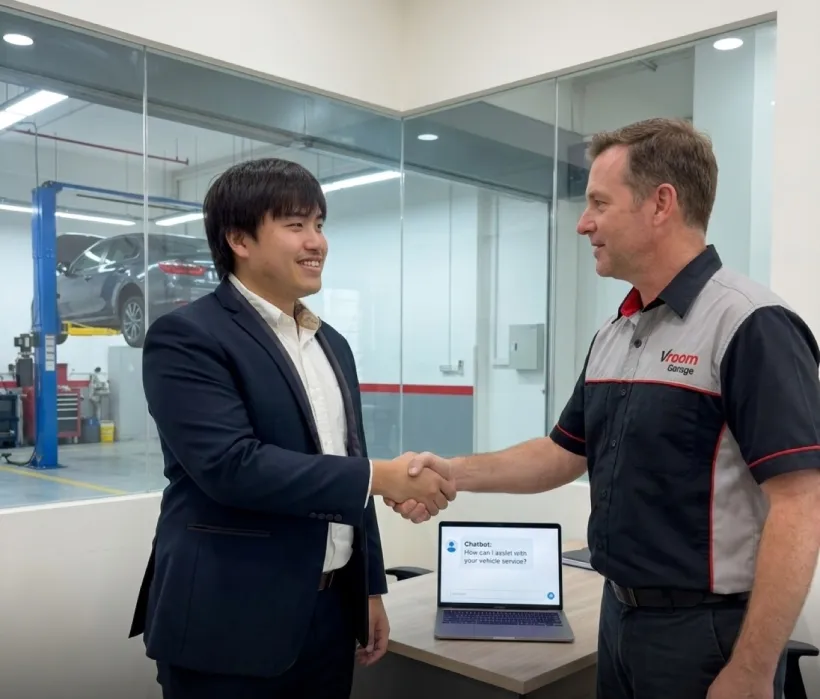
- Auto workshops and trades — customer-service bots, quote follow-ups and job reminders (see the Vroom Garage chatbot below).
- Clinics and wellness — appointment reminders, intake forms and no-show follow-ups, handled in line with PDPA.
If your business runs on repetitive messages, spreadsheets and follow-ups, there's almost certainly something here worth automating. Not sure where to start? A free automation audit (below) is the quickest way to find out.
An honest case study — the 2247 Rental Hearts automation bot
2247 Rental Hearts came to me with enquiries scattered across chat messages and no reliable way to keep track. We built a Telegram bot wired to an Excel workflow: the team drives it from Telegram, and the bot captures each enquiry, structures it and keeps the underlying Excel records in sync — turning a messy stream of messages into a single, tidy, searchable record. It was delivered and handed over in person, and it does one job well.
I'm deliberately not going to quote you a "300% productivity" figure, because I don't invent numbers. What I can tell you honestly is what was built and that it works — a small, reliable automation that removed a daily manual chore. I've built similar systems for other Singapore businesses: an auto-purchase e-commerce bot for Susy & Bae, a customer-service AI chatbot for Vroom Garage (an auto workshop), delivered across three milestones, and an auto-booking and form-filling system for CONSULAR MW. Different tools, same philosophy: scope one painful job, automate it properly, and hand it over working — each one delivered in person, so nobody is left with a workflow they can't run.
Automation or an AI agent — which do you actually need?
There's a lot of noise about "AI agents" right now, so here's the plain-English version. Practical automation follows rules you can predict: when this happens, do that. It's reliable, cheap and easy to trust — which is why it's the right first step for most SMEs. An AI agent goes further: it decides and acts more autonomously across a workflow, which is powerful but needs guardrails, logging and human checkpoints. Plenty of vendors slap "AI agent" on what is really a basic automation to charge more — that's agent washing, and I'll never do it. If a S$400 automation solves your problem, I'll build that, not a S$30,000 "agent" you don't need.
Can EDG or PSG grants help pay for automation?
Sometimes, and it's worth checking before you spend. Qualifying custom-software and process-transformation projects may be supportable under the Enterprise Development Grant (EDG) — typically up to around 50% of qualifying costs, subject to eligibility and approval — and I'm happy to help you frame a scope you can take to a consultant to check. A quick note on the other grant people ask about: the Productivity Solutions Grant (PSG) funds pre-approved, packaged solutions, so bespoke automation and dedicated-developer time generally do not qualify — I won't tell you otherwise just to close a deal. For the fuller picture, read my guide to EDG and PSG grants for software and the SME AI adoption and Budget 2026 grants roundup. This isn't grant or legal advice — confirm current eligibility with Enterprise Singapore.
What automation costs and how a build runs
Instead of a big project fee, you get a dedicated developer from S$400/month (Starter Squad) or S$550/month per developer on the Product Team plan — SGD, always (see pricing). Because my developers are full-time team members, not local hires, there's no CPF and no foreign-worker levy — real on-costs you carry on a local employee — which is a big part of why I'm cheaper than an agency or an in-house automation engineer. Prefer to plug a dedicated automation developer straight into your team? That's staff augmentation. A typical engagement runs like this:
- Free automation audit — we map your repetitive tasks on a quick WhatsApp call and pick the one with the fastest payback.
- Scope and quote — I turn it into a simple plan with a fixed monthly cost, and flag anything that could qualify for EDG.
- Build and test — you see it working on your real data, usually live in under two weeks (urgent jobs in 3–5 days).
- Handover — workflows, code, credentials and a short how-it-works doc, all yours, often delivered in person.
Every engagement includes an NDA and 100% IP assignment, personal data handled in line with Singapore's PDPA, a 30-day replacement guarantee, and no lock-in. For most owners, done-for-you automation is the lowest-risk way to get real time back this month, without a big project fee or a long lock-in contract to sign first.
Frequently asked questions
How much does business automation cost in Singapore?
You get a dedicated developer from S$400/month (Starter Squad) or S$550/month per developer on the Product Team plan — SGD only, no per-project agency fee. A focused first automation, say WhatsApp lead follow-up wired to your Google Sheet, is usually live in under two weeks, so a first project often lands in the hundreds of dollars rather than the tens of thousands agencies quote. After a free audit I give you a fixed monthly cost so there are no surprises.
Why are you cheaper than a local automation agency or an in-house hire?
Two reasons. My developers are full-time team members based in Indonesia (one hour behind Singapore), so you carry no CPF and no foreign-worker levy — real on-costs that stack up on a local hire, where a comparable mid-level developer can run around S$6,000–12,000 a month once you load salary, CPF and overheads. And I run lean and founder-led, so you are not paying for agency overhead or layers of account managers. Cheaper here means lower cost, not lower care — I still hand every build over in person.
What's the difference between automation and an AI agent?
Automation follows fixed rules you can predict — when X happens, do Y — which makes it reliable and cheap. An AI agent decides and acts more autonomously across a workflow, which is more powerful but needs guardrails, logging and human checkpoints. Most SMEs should start with automation; if you genuinely need autonomy, see my agentic AI development page. I will never dress up a simple automation as an 'agent' to charge more.
Can I use EDG or PSG grants to fund this?
Possibly EDG — qualifying custom-software or process-transformation projects may be supportable under the Enterprise Development Grant (typically up to around 50% of qualifying costs, subject to eligibility), and I will help you frame a scope you can take to a consultant to check. PSG is different: it funds pre-approved packaged solutions, so bespoke automation and dedicated-developer time generally do not qualify. This isn't grant or legal advice — confirm current eligibility with Enterprise Singapore.
Do I need to replace my current tools?
No. The whole point of automation is to connect what you already use — Google Sheets, your CRM, WhatsApp, Telegram, email, your accounting tool — not force a migration. If you are already on Zapier or Make, I will usually build inside your existing stack rather than move you off it unnecessarily.
Zapier or Make vs n8n vs custom code — which is right for me?
If a no-code tool solves it in an afternoon, use the no-code tool, and I will tell you when that is the right call. I lean to self-hosted n8n or custom code when the workflow has real logic, higher volume, uses the WhatsApp Business API, or handles data you would rather keep off a third-party cloud — it is usually cheaper and sturdier over a year. My rule is the lightest option that reliably does the job.
Can you automate WhatsApp safely without getting my number banned?
Yes. I build on the official WhatsApp Business API and approved messaging patterns rather than grey-area hacks, so your automation stays within WhatsApp's rules. For lighter needs I will advise the safest approach for your volume and use case so you don't risk your main line.
What happens after handover? Am I locked in?
No lock-in. At handover you get the workflows, code, credentials and a short how-it-works doc — all yours to keep. Most clients keep a developer on a light monthly basis to maintain and extend the automation, but you are free to run it yourself or hand it to your own team. And if an app changes its API and something breaks, I am here to fix it.
Do you sign an NDA and follow PDPA?
Yes. Every engagement starts with an NDA and 100% IP assignment, so everything I build is yours from day one. I handle personal data in line with Singapore's PDPA, and for sensitive data I will recommend self-hosted options so your information stays under your control rather than sitting in a third-party tool.
How long until my first automation is live?
Usually under two weeks for a focused first workflow, and 3–5 days for urgent jobs. We start with a free automation audit to pick the highest-payback task, then build and test on your real data so you see it working before handover — no big-bang project that drags on for months.
Let’s scope it — free
WhatsApp me your requirements and I’ll reply within the hour (Mon–Fri) with an honest read and a fixed quote. From S$400/month per developer, no lock-in, 100% IP yours.
WhatsApp me →Related guides
- AI automation agency selection checklist
- AI automation ROI calculator
- AI software development cost in Singapore
- Singapore SME AI adoption and grants