Agentic AI development Singapore has moved from conference-slide hype into systems that quietly run real work — triaging customer messages, chasing quotes, reconciling orders and filing the paperwork nobody enjoys. Across the island, SME owners are being pushed to "do something with AI", yet most I meet are stuck between that vague pressure and a five-figure agency proposal that never ships. I'm Joshua. I personally scope, build and hand over agentic AI systems for Singapore SMEs and startups — AI agents that don't just answer questions but do work, with the guardrails to run them safely.
What "agentic" actually means — and when you don't need it
An ordinary AI chatbot answers questions. An agent takes actions: it reasons about a goal, calls tools, and moves a workflow forward — booking the slot, updating the CRM, raising the ticket, sending the follow-up — pausing for a human where the stakes are high. A chatbot might tell a customer your next free service slot; an agent can check the real calendar, hold the slot and draft the confirmation for staff to approve. That difference matters, because "agent" has become the most over-sold word in tech. Plenty of vendors slap the label on a glorified FAQ bot; the buyer's-guide term for it is agent washing. My first job on any project is to tell you honestly which of three things you actually need — a simple rule-based automation, a conversational chatbot, or a genuine autonomous agent. Often the cheapest option is the right one, and I'll say so before you spend a dollar.
What agentic AI can do for a Singapore SME
The best first agent is narrow: one painful, repetitive workflow where a mistake is recoverable and the volume is high enough to feel the relief. The patterns I build most often:
- Customer-service agents — WhatsApp or web agents that answer routine questions, check availability, book appointments, and hand messy or high-value cases to a human with the full context attached.
- Sales & lead-qualification agents — capture an enquiry, ask the right qualifying questions, tag and route it into your CRM, and follow up on the ones that go cold.
- Back-office agents — read invoices and delivery orders, extract the fields, update your sheet or accounting tool, and flag anything that doesn't reconcile.
- Operations & monitoring agents — watch inventory, prices or inboxes, summarise what changed, and trigger the next step — often as a Telegram or Slack workflow your team already lives in.
- Knowledge agents (RAG) — answer staff or customer questions grounded in your documents — SOPs, product data, policies — instead of the open internet, so replies stay on-brand and on-fact.
Most of these overlap with plain AI automation; the "agentic" upgrade is letting the system decide and act within limits you set, rather than following one fixed script. Start with the workflow that eats the most of your team's day — that's where an agent pays for itself fastest.
Chatbot vs automation vs agent — which do you actually need?
Use this to sanity-check any AI proposal you're handed, including mine:
| Rule-based automation | AI chatbot | Agentic AI | |
|---|---|---|---|
| What it does | Follows a fixed script or trigger | Understands language, answers questions | Decides and takes actions toward a goal |
| Autonomy | None — you define every step | Low — responds, doesn't act | Bounded — acts within permissions you set |
| Best for | Predictable, repeatable tasks | FAQs, triage, first-line support | Multi-step workflows across tools |
| Governance needed | Low | Low–medium | Medium–high (logging, approvals, kill switch) |
| Typical first build with me | Days | 1–3 weeks | 4–8 weeks for one workflow |
If a rule-based automation or a chatbot solves your problem, that's what I'll quote — it's faster, cheaper and easier to trust. I only reach for a full agent when the workflow genuinely needs judgement across several steps and tools. Paying for autonomy you don't need is one of the most common ways SMEs waste an AI budget.
Governance built in — the IMDA agentic AI framework
Because an agent takes real actions, a mistake is a wrong action, not just a wrong answer — a booking made in error, an email sent to the wrong client, a record overwritten. That's why I build every agent to the principles in IMDA's Model AI Governance Framework for Agentic AI (published January 2026). It's voluntary guidance rather than law, but designing to it gives you a defensible position from day one and protects you when a customer, auditor or partner asks how the system is controlled. In practice that means:
- Scoped permissions — the agent can only touch the specific tools and data its job requires, nothing more.
- Human-in-the-loop checkpoints — high-stakes actions (payments, external emails, irreversible changes) pause for a person to approve.
- Full action logging — every decision and action is recorded, so you can audit exactly what happened and why.
- A kill switch and rollback path — you can stop the agent instantly and undo, without calling a developer at midnight.
I've written a plain-English breakdown of what the IMDA framework means for SMEs if you want the detail before we start. Getting governance right early is not red tape — it is what lets you widen the agent's remit later without lying awake wondering what it might do unsupervised.
Industries I build agentic AI for
Sixty-plus delivered projects since 2019 mean I've seen how these workflows differ by sector. A few I work with regularly:
- Retail & e-commerce — order-status agents, product-finder assistants and back-office reconciliation for online stores.
- F&B & hospitality — reservation and enquiry agents that handle the WhatsApp flood without a full-time coordinator.
- Automotive & workshops — service-enquiry and booking agents (see the Vroom Garage story below).
- Professional services — intake, quoting and document-drafting agents for agencies, clinics and consultancies.
- Property & real estate — lead-qualification and listing-enquiry agents that never miss an after-hours message.
- Logistics & trading — invoice and delivery-order processing plus inventory-monitoring agents that cut manual data entry.
An honest case study: Vroom Garage
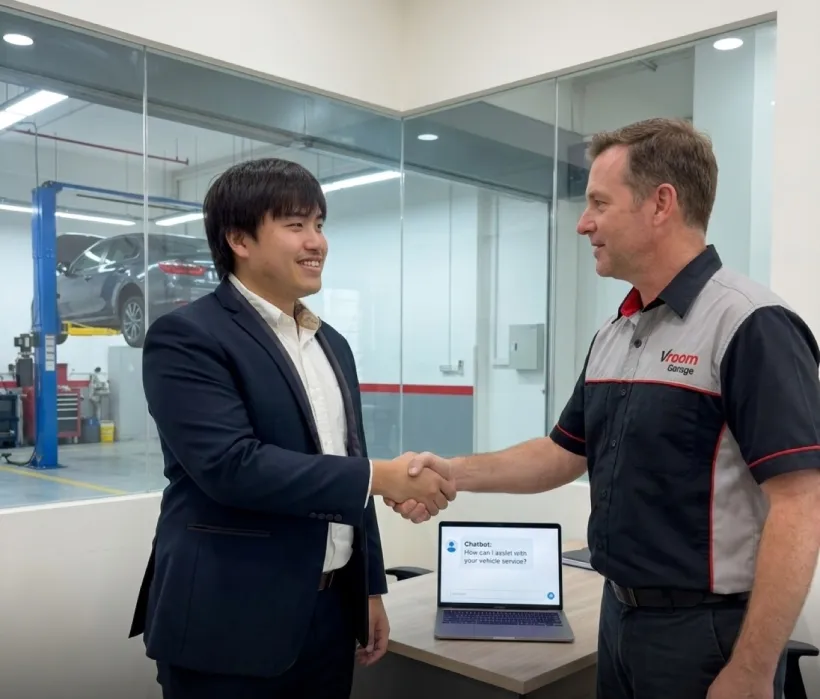
Vroom Garage is an auto workshop I built a customer-service AI chatbot for, delivered and handed over across three milestones. The bot handles the routine enquiries a workshop gets all day — service types, what's involved, opening hours, what to ask when booking — so the team isn't retyping the same answers. It's a chatbot today, and I won't dress it up as more than that. What makes it a useful example is the direction of travel: the honest next step is agentic — letting it check real slot availability and draft a booking for staff to confirm, rather than only answering. That's exactly how I like to sequence these projects: earn trust with a reliable assistant first, then add autonomy one guarded action at a time. I'll happily describe what was built and how it works; I don't attach invented metrics to any client.
What it costs — and where grants fit
Local agencies often quote five figures for an "AI project", frequently for something that never reaches production. With my dedicated-developer model you pay from S$400/month per developer (Starter Squad) or S$550 on the Product Team plan — no CPF, no foreign-worker levy, no lock-in, and a 30-day replacement guarantee. A focused first agent covering one workflow typically runs 4–8 weeks. See full pricing for the plans.
Beyond the build, a live agent has a small ongoing running cost — the LLM API usage and any hosting — which is usually modest at SME volumes and billed to you at cost, with no hidden markup. I estimate it up front so there is nothing surprising on your monthly bill, and a well-scoped agent should save far more in staff time than it spends.
On grants, honestly: a qualifying custom-software project may be supportable under the Enterprise Development Grant (EDG) — typically up to around 50% of qualifying costs, subject to eligibility — and I'll help you check and prepare what an application needs. The Productivity Solutions Grant (PSG) funds pre-approved packaged solutions, not bespoke agent development or human staffing, so I won't pretend this service is "PSG-eligible". This isn't grant or legal advice — confirm current eligibility with Enterprise Singapore. There's more detail in my guide to EDG and PSG grants for software development.
How an agentic AI project runs
- Pick one painful workflow — we scope a narrow, high-value first agent, not a do-everything bot. I turn it into a milestone plan with a fixed monthly cost, free.
- Prototype in weeks — a working agent on your real data, with human-in-the-loop checkpoints, so you can feel it before you commit further.
- Harden & deploy — permissions, logging, monitoring, a kill switch and a rollback path all go in before it goes live.
- Hand over & expand — code, docs and credentials are yours (often delivered in person). Once the first agent earns trust, we extend it or add the next.
You are never locked into a black box between milestones. Each stage produces something you can see, test and switch off, and every review is a genuine go/no-go — if the numbers don't justify the next phase, I'll tell you to stop.
Why run your agentic AI development Singapore project with me
You work directly with me — I scope the agent, lead the build and hand it over working, so you're never buying a black box. My developers use Cursor, Claude Code and agentic workflows every day, which means we build with the same class of tools we deploy, not last year's playbook. When a plain automation beats an "agent", I'll tell you, and when a use case isn't ready, I'll tell you that too. If you later need broader engineering help, the same team covers custom software development — one relationship, no agency mark-up. Every engagement includes an NDA, full IP assignment and data handling aligned to Singapore's PDPA, so what we build, and the data it touches, stays entirely yours.
Frequently asked questions
What's the difference between a chatbot and an agentic AI system?
A chatbot answers questions. An agentic AI system takes actions — it can check availability, update records, send messages or move a workflow forward on its own, pausing for a human where the stakes are high. If you only need first-line answers, a chatbot is cheaper and I'll recommend that instead.
How much does it cost to build an AI agent in Singapore?
From S$400/month per dedicated developer (S$550 on the Product Team plan), with no CPF, no levy and no lock-in. A focused first agent covering one workflow typically takes 4–8 weeks — far below the five-figure fixed bids common at AI agencies, many of which never reach production. There's also a modest ongoing running cost (LLM API usage and hosting), billed to you at cost.
Why are you so much cheaper than an AI agency?
No agency overhead, and no local-hire on-costs. My vetted developers are based in Indonesia (one hour behind Singapore), so you skip CPF and the foreign-worker levy while I lead the work from Singapore. You get senior attention without the five-figure project mark-up common at AI agencies — many of which never ship to production.
Can I use EDG or PSG grants for this?
Possibly EDG. A qualifying custom-software project may be supportable under the Enterprise Development Grant (typically up to around 50% of qualifying costs, subject to eligibility), and I'll help you check. PSG funds pre-approved packaged solutions, not bespoke agent development, so I won't claim this service is PSG-eligible. This isn't grant or legal advice — confirm current eligibility with Enterprise Singapore.
Is agentic AI compliant with Singapore's rules?
IMDA's framework for agentic AI (January 2026) is voluntary guidance, not law. I build to its principles by default — bounded permissions, human accountability, technical controls and full logging — which gives you a defensible governance position from day one.
How do you stop the agent from doing something wrong?
Scoped permissions (it can only touch what its job needs), human-approval checkpoints for high-stakes actions, complete action logging, and a kill switch with a rollback path. We test on real data with a human in the loop before anything runs autonomously.
What happens after handover?
You get the code, documentation and credentials — often handed over in person — and you own all of it. Most clients keep a developer on a light retainer for tweaks and new agents; others run it with their own team. Either path is fine, and there's no lock-in.
Do you sign NDAs and follow PDPA?
Yes. Every engagement includes an NDA and 100% IP assignment, and data is handled in line with Singapore's PDPA. Your data, prompts and customer records stay yours.
Can the agent work with my existing systems?
Yes — agents connect to the tools you already use (WhatsApp, email, Google Sheets, CRMs, databases, accounting tools) via their APIs. We scope the integrations up front so the agent works where your team already works.
How long until my first agent is live?
Most first agents are live in about 4–8 weeks depending on integrations; a simpler chatbot can be days to a couple of weeks. Urgent builds can start within 3–5 days. I'll give you a milestone timeline before we begin.
Which AI models and tools do you use?
I'm model-agnostic and pick what fits the job and budget — typically leading LLM APIs plus RAG over your own data, orchestrated with modern agent frameworks. My team builds with Cursor and Claude Code daily, so we deploy the same class of tools we work with.
Let’s scope it — free
WhatsApp me your requirements and I’ll reply within the hour (Mon–Fri) with an honest read and a fixed quote. From S$400/month per developer, no lock-in, 100% IP yours.
WhatsApp me →Related guides
- AI software development cost in Singapore
- AI automation agency selection checklist
- IMDA agentic AI governance guide
- CSA AI security guidance